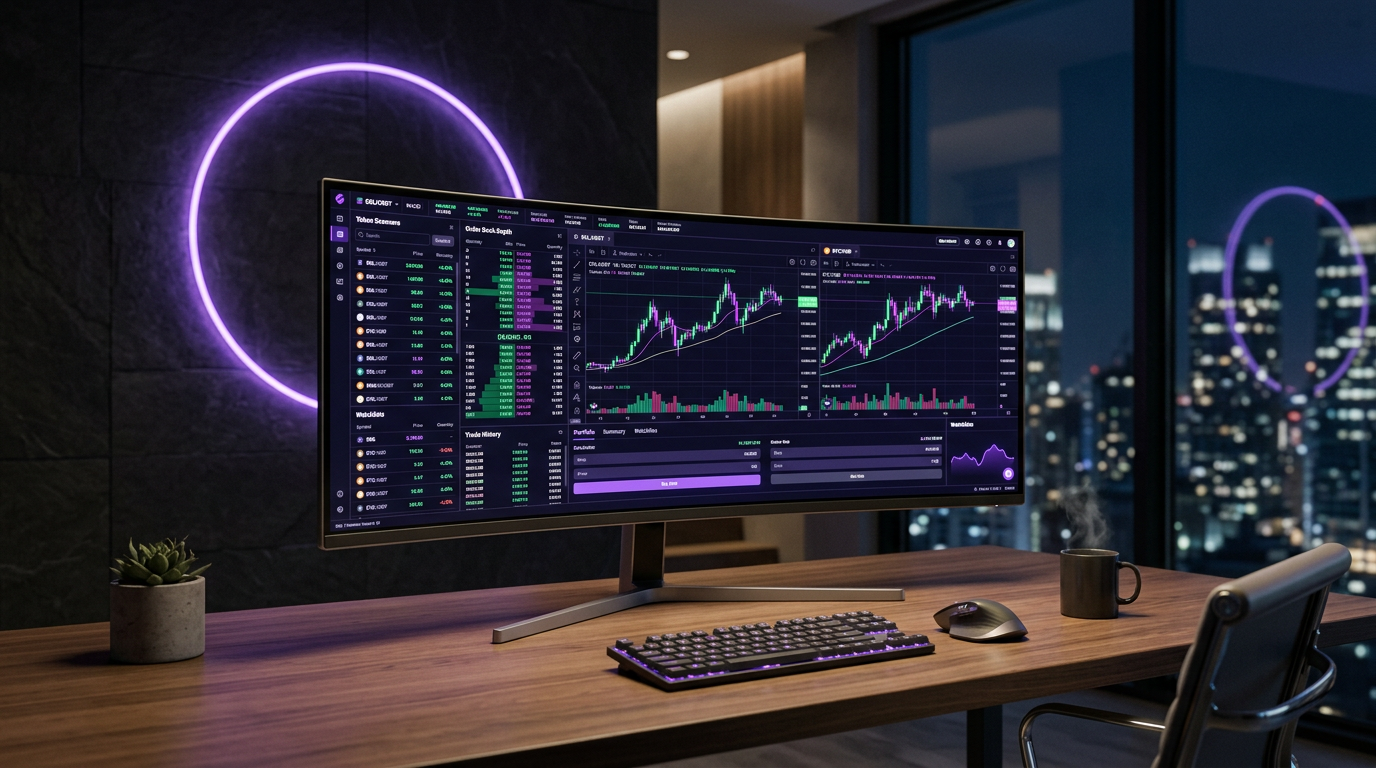
OrbitX DEX
Trade with live intel
Screener, scanner, charts and one-click execution.
 ORBITX
Buy $ORBITX
$ORBITX · Solana
Origin before narrative.
Discover, analyze, trade, launch, and socialize — in one connected environment.
The ad · 30 seconds
OrbitX OS is live. Your entire on-chain world, on one desktop.
Why OrbitX
See who deployed, whether the dev sold and who bought first, before the timeline sells you a story.
Wallet and KOL tracking, plus a leaderboard built from realized on-chain PnL and win rate.
Scanner, DEX, alerts, social and AI share one login, one identity and one context.
Feeds, communities, DMs and live voice rooms, with charts and tokens right inside posts.
OrbitX AI and the MCP let Claude, ChatGPT or Grok scan, analyze, trade and launch with you.
Wallets are created and encrypted on your device behind a PIN. Keys never reach the server or AI.
Latest articles
A customizable crypto desktop, AI-powered token launches, a social hub wired into trading, and OrbitX City.
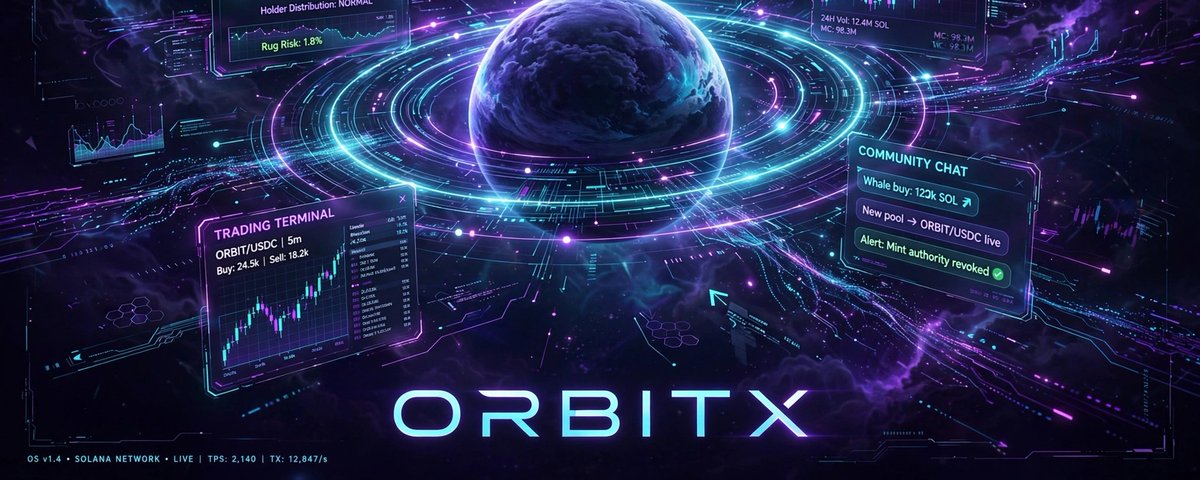
How a personal rug scanner became Sol Tools, then OG Scan, then an OS with its own MCP.
Snapshot Nov 4, 2026
Drag to compare
 Before
After
Before12 tabs, 8 tools, zero signal
AfterOne desk
Community
Updates, calls and the people building OrbitX, on X and Telegram.
Spin · tap · go
Drag or swipe to spin. Tap a card to open it.
Every official link
Bookmark this. Share this. Only trust these.
Token
Apps
Shipping now
Three products, one login.
OrbitX DEX
Screener, scanner, charts and one-click execution.
Smart money
Wallet history, win rate, PnL, KOL labels and whale alerts.

Launchpad
Anti-rug safeguards, anti-vamp checks and auto-listing.
The token
Snapshot Nov 4, 2026 · 2:00 PM ET · OrbitX scan
13H4WJvGEg4xrrBwWn2vsQgz7xhmhxgNdw19i1QsxPX9Where it's going
Phase 1 · Now Live
Core intelligence, trading and social.
Phase 2 · Near-term
Deep KOL tools, AI analyst, voice lobbies and Spaces.
Phase 3 · Coming
Social graph, on-chain identity, copy-trading, multi-chain, mobile.
Phase 4 · Vision
The default OS for serious on-chain activity.
AI agents · Life City

@handle.obx, thinks, tweets, converses, writes daily logs and publishes desk sites.Agent MCP
Works with Claude, ChatGPT and Grok.
https://www.orbitx.world/api/mcpMCP access is free until Nov 7, 2026. After that, burn $ORBITX to unlock it:
For promoters & KOLs
Logos, ads and captions, ready to go.
Captions
Still juggling 12 tabs to trade Solana? OrbitX puts the scanner, smart-money tracking, DEX and launchpad in one desk. $ORBITX 🪐 orbitx.world
Know who's buying before the chart does. Wallet forensics, KOL labels and whale alerts, live on OrbitX. $ORBITX orbitx.world
Launch with control. Anti-rug safeguards and anti-vamp checks from minute one on the OrbitX Launchpad. $ORBITX
Plug your AI into Solana. OrbitX Agent MCP works with Claude, ChatGPT and Grok — free until Nov 7. orbitx.world/agent $ORBITX
About
An all-in-one Solana trading intelligence platform and on-chain operating system.
Open OrbitX and it feels less like visiting a website and more like logging into your own computer. A customizable desktop lets you move apps around, sort them into folders and set your own wallpaper. Your trading tools, social feed, launchpad and AI all run inside the same environment.
Install it on your phone or computer and it runs like an app, without digging through a browser every time.
One login. One identity. One design language.
The story
Sol Tools
A developer wanted to check a token for rugs and couldn't find a tool worth using, so he built his own scanner. Token tracking and a sniping tracker followed.
OG Scan
The scanner grew up around one idea: origin before narrative. Traders kept asking for wallet tracking, alerts, leaderboards and a place to talk.
OrbitX
A rebuilt product and a new name, because the old one promised a scanner and the product had become an environment.
OS + OrbitX MCP Now
A desktop-style operating system for Solana, and an MCP that brings the whole system into Claude, ChatGPT and Grok.
The journey wasn't linear: the first app was rebuilt as a website, then rebuilt again, and again. Every version taught something the last one couldn't.
OrbitX is built in public. People could watch it improve in real time, and the people using it helped shape what came next.
What you can do
Holder breakdowns, dev and first-buyer forensics, liquidity and rug checks, a risk score and a clean trade panel.
Follow smart money: what they buy, hold and just dumped, with the receipts.
Realized PnL and win rate computed from on-chain swaps. No screenshots, just the chain.
Set conditions and get pinged when they hit. Stop refreshing charts at 3am.
Mint and freeze authority, LP lock and pull detection, concentration, dev behaviour and bonding status.
Feeds, communities, DMs and live voice rooms, with charts and tokens inside posts.
An assistant that answers about tokens, wallets and setups from live data instead of vibes.
A live launch feed, creator profiles and discovery tools. Launch a token by describing it to your AI.
Claude, ChatGPT and Grok can scan, analyze, trade, launch, mint NFTs, claim creator fees, post to X and generate media.
Immediate buys and sells in seconds, plus limit sells so you can set the outcome and step away.
A 3D world tied to $ORBITX where users own buildings, and the city grows with market cap.
Why OrbitX over other platforms
You stop being the integration layer between six platforms.
| Job | Typical stack | OrbitX |
|---|---|---|
| Discovery & scanning | A standalone scanner | Scanner & DEX with forensics and a risk score |
| Smart money | A separate wallet tracker | Wallet and KOL tracking plus a PnL leaderboard |
| Alerts | A Telegram bot | Smart alerts on your own conditions |
| Execution | A separate DEX and a wallet popup per action | In-app wallet, Phantom Connect and Jupiter |
| Conversation | A group chat | Social hub with live voice rooms |
| AI | An AI chat with no live chain data | OrbitX AI and the MCP on OrbitX data |
| Total | 6+ tabs, no shared context | One OS, shared context |
Nobody wants a popup — they want in and out.
Any single feature can be copied. The edge is the loop: better data improves decisions, better execution turns decisions into activity, activity strengthens the community and creates more context, and more context brings more users.
Security
Reliability
While the outage disrupted several other platforms, OrbitX kept running.
“Make Solana easier to understand, safer to navigate, faster to act on, and more social.”
Articles
Long-form posts from @orbitx_wrld, newest first.
A customizable crypto desktop, AI-powered token launches, a social hub wired into trading, and OrbitX City.
How a personal rug scanner became Sol Tools, then OG Scan, then an OS with its own MCP.
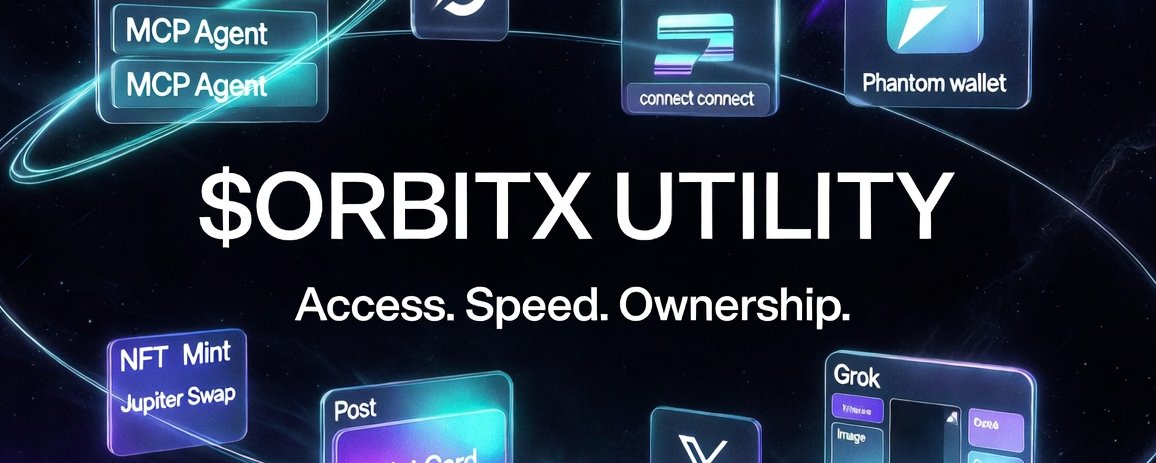
The access layer and value-capture mechanism for the OrbitX operating system: MCP access, fees, buybacks and burns.
From OG Scan to OrbitX: why the name changed, what lives inside the platform, and the problem it solves.
More
Orbitx 🌎@orbitx_wrld · Oct 30, 2026What if crypto didn't feel like juggling a dozen different tabs?
The crypto space has become increasingly fragmented. Traders jump between platforms just to research a token, analyze its holders, execute a trade, communicate with other users, or launch something new.
One platform provides the charts. Another provides wallet analytics. A third handles trading, while completely separate applications handle communities and social interaction.
It works, but it creates unnecessary friction.
OrbitX was built around a different idea: What if everything you needed to participate in crypto existed inside one connected ecosystem?
Rather than building another standalone trading website, we're building something much bigger — a complete crypto-focused operating system that brings trading, analytics, social networking, token launches, AI integrations, and more together under one roof.
When you open OrbitX, the experience is designed to feel less like visiting another website and more like logging into your own computer.
The platform features a customizable desktop environment where you can move applications around, organize them into folders, customize your wallpaper, and arrange your workspace however you want.
Your trading tools, social feed, launchpad, and other applications all operate within the same environment.
You can also install OrbitX on your phone or computer, giving you an app-like experience without having to repeatedly navigate through a browser.
The bigger vision is to create an environment where everything works together. Instead of opening ten different websites to accomplish ten different things, you have one operating system designed around the entire crypto experience.
Most trading platforms give you a chart, some trending tokens, and a few basic metrics.
But what does that actually tell you about the token you're about to buy?
OrbitX takes a much deeper approach to trading analytics. The goal is to give traders access to the information they need to understand what's happening behind a token, not just what its price is doing.
You can investigate token holders, explore wallet activity, examine what other assets wallets hold, and identify potential connections between different wallets.
This gives traders more context when evaluating a project and making decisions.
Nothing in crypto guarantees a successful trade, but having access to more information can make a significant difference. Especially in a market where a few minutes can completely change the outcome.
We're building trading tools for people who want more than a chart and a buy button.
One of the more interesting developments inside OrbitX is the ability to interact with the launchpad through AI.
Instead of navigating through multiple pages and manually completing every step, users can connect AI platforms such as ChatGPT, Claude, or Grok and simply describe what they want to launch.
The AI communicates with OrbitX through its MCP integration and can execute supported launchpad operations using the connected wallet.
Real tokens have already been launched through this approach.
The launchpad also includes a live feed of new launches, creator profiles, discovery tools, statistics, and functionality designed around monitoring early activity.
The idea is to make token creation more accessible by turning what would normally be a complicated process into something you can accomplish through a conversation.
And this is only one example of what becomes possible when you connect an entire platform to AI.
Crypto has always been a social industry, but the tools people use to communicate are usually disconnected from the tools they use to trade.
OrbitX is bringing those experiences together.
The social platform allows users to publish posts, join communities, interact with other members, and participate in discussions.
But there's a difference: the social experience is connected directly to the trading ecosystem.
Charts, token information, and trading functionality can be integrated into posts, allowing users to explore opportunities without constantly leaving the conversation.
Communities are also expanding with live voice rooms, creating another way for people to communicate beyond traditional text-based discussions.
The objective is straightforward: bring the people, conversations, information, and tools together in one place.
Building a platform that handles trading and wallets means security has to be a priority from the beginning.
OrbitX uses PIN-protected wallet encryption designed to keep private keys inaccessible to the server while wallets are locked.
Wallet creation and encryption happen locally on the user's device, and private keys are not uploaded to the backend.
Unlock sessions are time-limited, with additional protections against repeated incorrect PIN attempts.
Private keys are also not accessible through MCP or external AI integrations.
The goal is to give users access to powerful functionality without sacrificing control over their own funds.
Reliability is equally important. During a major internet outage that disrupted several other platforms, OrbitX continued operating.
When people rely on a platform to trade and manage their assets, infrastructure and security cannot be treated as optional features.
OrbitX extends beyond traditional applications with OrbitX City, a 3D environment connected to the ORBITX token.
Users can own buildings within this digital world, and the environment evolves alongside the token's market capitalization.
As the ecosystem grows, additional buildings appear, creating a visual representation of its development.
There are also plans to connect platform activity with token burns, introducing a mechanism through which ecosystem usage can contribute to reducing token supply.
It's another example of the direction we're taking: building an ecosystem where the different components aren't isolated products but interconnected parts of something larger.
OrbitX is continuously expanding. Some features are already available, while others are part of the longer-term development vision.
The important distinction is that OrbitX isn't being built around a single product or a fixed endpoint.
We're building an ecosystem that can continue expanding as new technologies, ideas, and community demands emerge.
OrbitX was never intended to be just another collection of crypto tools packaged inside a website.
The vision has always been bigger.
A complete operating system for crypto. A place where trading, research, social interaction, token creation, AI, and digital experiences operate together.
We're not interested in building another platform that gives you one feature and sends you somewhere else for everything you actually need.
We're building the infrastructure to bring those experiences together.
One ecosystem. One identity. One environment. An entirely different way to interact with crypto.
Welcome to OrbitX.
$ORBITX is being built differently.
Its purpose is to function as the access layer and value-capture mechanism for a full on-chain operating system focused on trading, launching, analysis, and automation.
The core problem OrbitX is solving is fragmentation and speed.
Serious Solana traders currently move between multiple disconnected tools: a scanner for discovery, a separate interface for holder and wallet analysis, another for execution, additional platforms for launching tokens or claiming fees, and AI chats when they want to reason about a contract.
Every switch costs time. In a market where opportunities appear and disappear within minutes, that friction is expensive.
OrbitX is designed as a single connected environment.
Token discovery, forensic data, wallet intelligence, trading execution, token launches, NFT minting, creator fee claims, social posting, and AI-assisted analysis all live in one place.
The $ORBITX token sits at the center of this system.
Holding the token grants access to the OrbitX MCP layer.
MCP (Model Context Protocol) allows compatible AI systems such as Claude, ChatGPT, and Grok to interact directly with OrbitX tools.
Instead of manually navigating multiple interfaces, users can provide a contract address and request analysis, risk assessment, holder distribution insights, or trade preparation through natural conversation.
The same connection supports buying and selling, minting NFTs, launching tokens, claiming creator fees, posting to X, and generating images or video content.
The data and actions are powered by OrbitX’s own screening, forensic, and execution infrastructure rather than generic public information.
This matters because the most important factors in on-chain trading are speed of understanding and speed of execution.
When a user can give a contract to an AI agent that already has access to OrbitX’s live data layer, the time between discovery and an informed decision is reduced dramatically.
The platform is built around high-performance execution using Phantom Connect and Jupiter. Transactions are designed to settle quickly through a responsive interface, reducing the lag that can turn a correct idea into a late entry.
The platform takes a small fee on relevant actions including fee claims, buys, sells, NFT mints, and token launches.
These fees are used for platform growth, marketing, and expanding tools and infrastructure.
A portion is allocated toward buybacks and burns executed from the development wallet. Additional holder distributions through airdrops are part of the planned structure.
As usage increases, more activity flows through the fee system, creating a stronger connection between platform adoption and token economics.
Future development is expected to expand exclusive features and tools available only to token holders, further aligning long-term participation with access.
The project is being built with a longer time horizon than typical launchpad or scanner cycles.
The goal is not to create a temporary product that captures attention during one market phase and then disappears.
The goal is to build lasting infrastructure that changes how participants interact with Solana:
$ORBITX is the token that gates access to the MCP tooling and participates in the value created by platform activity.
Whether this design succeeds depends on continued development, actual usage, execution, and market conditions.
Readers should evaluate the live product, the code, the on-chain mechanics, and their own risk tolerance independently.
Contract: 13H4WJvGEg4xrrBwWn2vsQgz7xhmhxgNdw19i1QsxPX9
Website: orbitx.world
GitHub: github.com/audifyx/og-scan
This is not financial advice. Do your own research. Nothing written here constitutes a recommendation to buy, sell, or hold any token.
Orbitx 🌎@orbitx_wrld · Sep 24, 2026OrbitX did not begin with a grand plan to rebuild the Solana trading experience.
It began with a simple problem: I wanted to check a token for rugs, and I could not find a tool I actually enjoyed using. The options were incomplete, covered in ads, missing important data, or built with interfaces that made basic research harder than it needed to be.
I remember thinking: I am a developer. I build websites. Why don’t I just make a better one for myself?
So I did.
That small decision became the beginning of OrbitX.
What started as a personal scanner slowly became a suite of tools. The suite became a social platform. The platform became an operating system. And now, with the OrbitX MCP, that entire system can live inside an AI conversation.
This is the story of how we got here, what OrbitX is becoming, and why we believe the future of trading can be faster, more connected, and far less fragmented.
The first version was called Sol Tools.
There was no complicated vision behind the name. It described exactly what the product was: a set of useful tools for Solana, beginning with a scanner that helped me understand whether a token looked dangerous.
Once the scanner worked, the next question came naturally:
What else should exist beside it?
Token tracking came next. Then a sniping tracker. Then more research and market tools.
Every new feature exposed another missing part of the workflow.
A trader does not only scan a token. They discover it, research it, study the wallets around it, watch the market, talk to friends, make a decision, and eventually act.
The more I built, the clearer it became that the real problem was not the absence of tools.
Crypto already had plenty of tools.
The problem was that they were scattered everywhere.
Research lived on one site. Charts lived on another. Wallet activity lived somewhere else. Conversations happened in a group chat. Execution happened inside a wallet.
Every step required another tab, another interface, another copy-and-paste, and another interruption.
Sol Tools was growing because the workflow itself was fragmented.
As the product evolved, it became OG Scan.
OG Scan focused on scanning established or “OG” coins. It was a strong product for what it was, but eventually the name became too small for the system forming around it.
We were no longer building one scanner for one type of token.
We were building an environment.
That is when OrbitX became the final and most fitting name.
OrbitX represents the idea that many different products can orbit the same user, wallet, data, and community.
A scanner, chart, portfolio, group chat, trading engine, and launchpad should not feel like unrelated websites. They should behave like parts of one connected system.
The journey was not linear. I built the original app from scratch, reached around 50 early users, rebuilt it as a website, then rebuilt that website again—and again.
Each version taught me something the previous version could not.
Those rebuilds were not wasted work. They were how I discovered what OrbitX actually wanted to become.
The current OrbitX interface is built around a familiar idea: a phone filled with apps.
When you enter OrbitX, each product opens like its own application, but every application remains part of the same environment.
You are not being thrown between disconnected websites. You are moving through one operating system built specifically for Solana.
That design is more than a visual choice.
An operating system creates continuity.
The token you discover can become the token you scan, chart, discuss, track, and trade. Your identity, wallet, data, and community remain close throughout the journey.
Today, the main platform has roughly 140 users and an active community. That is still early, but it proves something important.
A tool originally built for one person became useful to friends. Friends shared it with other traders. We started building publicly, posting updates, collecting ideas, and forming a real community around the product.
OrbitX has grown because people could see it improving in real time—and because the people using it helped shape what came next.
We are never done building. Every version creates the foundation for a better one.
It is easy to describe OrbitX by listing features.
That misses the point.
A scanner is useful. A chart is useful. Wallet intelligence is useful. A group chat is useful. A trading engine is useful.
But the real power appears when all of them share context.
A trader should be able to discover a token, understand its risks, inspect the wallets around it, discuss it with friends, decide what to do, and execute—all without becoming the integration layer between six different platforms.
That is the OrbitX thesis:
Shorten the distance between discovering an opportunity, understanding it, discussing it, and acting on it.
The website gives that system a visual home. The MCP gives it a conversational interface.
They are not competing products. They are two ways to access the same OrbitX infrastructure.
Someone who uses OrbitX through an AI assistant is still using OrbitX data, tools, wallets, trading infrastructure, and community—just through a different interface.
The website is one client. The MCP is another.
The infrastructure underneath them is the real product.
The OrbitX MCP is one of the biggest steps we have taken.
MCP allows compatible AI assistants to use OrbitX capabilities directly.
Instead of manually opening a scanner, copying a contract address, checking another site, opening a wallet, reviewing a quote, and signing through a popup, the user can express what they want in plain language.
They can ask the assistant to find a token, analyze it, inspect risks, study wallets and market activity, check whether it can be traded, prepare an action, and execute through the same OrbitX account.
The important innovation is not simply the number of tools available.
The breakthrough is orchestration.
The assistant can choose the right OrbitX capability for the moment while preserving the user’s intent across the interaction.
What used to be a sequence of disconnected tasks can become one continuous conversation:
The user no longer has to know where every function lives. They describe the outcome, and OrbitX helps assemble the path.
The hardest part of agent-native trading is not finding data.
It is execution.
An assistant can analyze a token in seconds, but if every action ends with another wallet connection, another application, and another popup, the experience is still broken.
That is why the in-app wallet became a turning point for OrbitX.
With an authenticated OrbitX wallet and the proper authorization in place, a user can move from analysis to execution without being pushed out of the conversation for every action.
The principle is simple:
Nobody wants a popup; they want in and out.
We have tested the live trading engine repeatedly. Once the required authentication is connected, immediate buys and sells can execute through OrbitX in seconds.
The result is not just a faster swap. It is a complete loop in which the user can gather data, make a decision, act, and verify the transaction without losing context.
Limit sells take that idea further. An immediate trade makes OrbitX useful while the user is present. A reliable limit sell lets the user define the outcome and step away. Buy-and-burn actions and other wallet functions expand the same infrastructure beyond a basic swap.
This is where OrbitX becomes more than an assistant that explains trading. It becomes an interface through which trading can actually happen.
That power also creates responsibility. Authentication must be clear. Failures must be honest. Transactions must be visible and verifiable. The user should always understand what OrbitX can do and what it has done.
Speed gets attention. Trust earns repeated use.
OrbitX is connected to major data sources because traders rarely make decisions from one signal.
Price and volume matter, but they are only the beginning. Serious token analysis can require holder distribution, liquidity, developer-wallet behavior, early-buyer activity, wallet history, market structure, chart context, and a clear answer to the most basic question: can this token actually be sold?
Putting that data in one place is useful.
Delivering the right piece of it at the exact moment a trader needs it is more powerful.
A static dashboard shows everyone the same panels. A conversational interface can respond to the user’s actual goal.
One trader may care about sellability and liquidity. Another may want wallet behavior. Another may need a quick risk summary before making a trade.
OrbitX can use the same underlying data differently depending on the question being asked.
We are not betting that traders want more tabs.
We are betting that they want the right evidence before they act.
Trading is often presented as a solo activity, but much of the best information moves between people.
Traders share contracts, compare interpretations, warn friends about risk, notice unusual activity, and build conviction together.
That is why OrbitX grew beyond research tools and added community features, leaderboards, group chats, and voice lobbies.
We were already trading with friends. The natural next step was to bring those relationships closer to the tools we used.
The MCP extends that social layer into AI clients. Users can interact with OrbitX communities and group chats from the same conversational environment used for research and trading.
The goal is not to attach a social feed to a terminal and call it innovation.
The goal is to make research, conversation, and action feel like parts of the same experience.
The Launchpad expands OrbitX from participation into creation.
Today, discovering a token and creating one are usually separate worlds. Launching involves names, symbols, metadata, wallet setup, deployment, fees, liquidity, promotion, community, and post-launch monitoring.
Our goal is to bring creation into the same operating system as discovery, research, community, and trading.
A token launched through OrbitX should enter an environment where people can discover it, inspect it, discuss it, chart it, and trade it.
Creators should be able to move from an idea to a living market and community without rebuilding their workflow across multiple platforms.
The Launchpad is still under active development, and some workflows require backend integrations, API keys, and production testing.
That distinction is important to us.
A product is not live because its button exists. It is live when it reliably does what it promises.
The OrbitX MCP is free to use today.
That gives people a low-friction way to try the product, lets us learn from real behavior, and gives the infrastructure time to prove its value.
Long term, OrbitX can charge for access in a way that directly supports the ORBITX token through buy-and-burn mechanics.
The idea is to create a relationship between product usage and the token economy rather than making the token itself the product.
If access is funded by buying and burning ORBITX, product use permanently removes supply.
That does not remove market risk, guarantee price appreciation, or replace the need to build a valuable product.
It creates a simple relationship:
More useful infrastructure → more users → more paid usage → more ORBITX purchased and burned.
Any individual OrbitX feature can be copied.
Someone can build another scanner, chart, swap route, chat room, or MCP server.
Features matter, but they are not the deepest advantage.
The moat is the loop formed when all of those features share context:
Better data improves decisions. Better execution turns decisions into activity. Activity strengthens the community and creates more useful context. More context attracts more users. More users create more activity, which supports further development.
This is why the MCP is not a side project and does not compete with the website.
Someone trading through a compatible AI assistant is still using OrbitX. The account, wallet, data, community, and execution remain inside the same system.
Every interface becomes another doorway into the platform.
OrbitX does not need to force every user onto one screen. It can become the infrastructure behind whichever screen they prefer.
OrbitX stands for speed, but not speed without context.
It stands for simplicity, but not simplicity created by hiding risk.
It stands for building in public, listening to the community, and treating every release as the foundation for the next one.
The mission is simple:
Make Solana easier to understand, safer to navigate, faster to act on, and more social to experience.
The data should arrive before the decision. The interface should get out of the way. The wallet should not interrupt every action. The community should remain close to the market. Creation should connect naturally to discovery and trading. AI should not only explain the system—it should help operate it within clear boundaries set by the user.
This is what we mean when we call OrbitX an operating system.
An operating system does not ask people to admire a collection of components.
It makes those components work together.
Trading is the live core. We will keep making execution faster, more reliable, and more transparent.
The Launchpad expands OrbitX from participation into creation.
The MCP will keep evolving as the agent-native version of the OrbitX operating system. Some workflows already function from end to end. Others still require backend integrations, API keys, and production testing.
Our standard is straightforward: a tool is not truly live until it works reliably, reports failure clearly, and gives the user a result they can verify.
Over time, the platform can support richer automation, persistent alerts, paper-trading environments, agent observation, social identities, and more advanced trading workflows.
But the roadmap is not about activating the largest possible number of features.
It is about making the entire loop deeper, safer, and more coherent.
We will keep building from real use. We will keep listening to traders and creators. And we will keep asking the same question that started all of this:
What can we build next that makes the whole experience better?
It is difficult to look at OrbitX today and remember that it began as one person trying to find a better way to scan a token.
Sol Tools solved a personal problem. OG Scan proved that a focused tool could become useful to other people. Rebuilding for the web turned that tool into a destination. Social features turned the destination into a community. The app-based interface turned the platform into an operating environment. The MCP opened that environment to conversational AI. The in-app wallet connected intelligence to execution. The Launchpad points from execution toward creation.
One idea kept revealing the next.
We are proud of how far OrbitX has come, but we are not pretending the work is finished.
Roughly 140 users are not the finish line. A large capability catalog is not the finish line. A working trade is not the finish line.
They are evidence that the central idea is real.
The Solana experience does not have to remain fragmented across endless tabs, wallets, chats, scanners, and dashboards.
It can be brought together into one coherent system—one that users can access visually through the OrbitX platform or conversationally through the OrbitX MCP.
The long-term goal is bigger than helping someone trade a few seconds faster.
It is to build infrastructure that lets people discover, understand, discuss, create, and act without carrying the burden of integration themselves.
That is what OrbitX has been becoming through every rebuild.
And we are not done building.
Explore OrbitX: orbitx.world
Follow the journey on X: @orbitx_wrld
From OG Scan to OrbitX: We Changed the Name Because We Outgrew It
OG Scan is now OrbitX.
Same team. Same obsession with on-chain truth. A completely rebuilt product, a new design, and a much bigger mission. If you trusted us to show you where a token really came from, you are going to like where this is going.
This is the long version. Grab a coffee.
We started as a scanner. A tool for one job done well: tell you the origin of a Solana token before the timeline tells you a story about it.
Who actually deployed it. Whether the dev already sold. Who the first buyers were. How concentrated the holders are. Whether the liquidity is real or a trap. The difference between a coin with an organic base and a coin that is one wallet wearing a costume.
That single idea, origin before narrative, was the whole product. And it worked. People used it to dodge rugs, to size up CTOs, to check a call before they aped. But every week the same thing happened: traders asked us to do more. Track this wallet. Alert me when this KOL buys. Show me the leaderboard. Let me chat about this coin. Give me a place to actually talk to other traders without the noise.
We kept bolting rooms onto a house that was designed as a single tool. At some point you stop renovating and you rebuild.
A name is a promise about scope.
"OG Scan" promised a scanner. But we are not a scanner anymore. We are the layer between a trader and the chain: discovery, verification, tracking, alerts, execution context, and community, in one place. The old name was a ceiling. Every time we shipped something that was not "scanning," we had to apologize for the name.
OrbitX is the promise we actually want to make.
An orbit is a system. Things that move together around a center. That is what we are building: a set of tools that all revolve around one thing, your edge on Solana. The X is for the frontier we keep pushing into, and for the network where our community actually lives. OrbitX is not a tool you open and close. It is the environment you trade inside.
To be clear about continuity: the data DNA did not change. Everything that made the scanner trustworthy is still under the hood, just faster, deeper, and wrapped in a product that finally matches the ambition.
This is the part that matters. OrbitX is an all-in-one Solana trading intelligence platform. Here is what lives inside it today:
Scanner and DEX. The original origin engine, rebuilt. Token pages with real holder breakdowns, forensics on the dev and first buyers, liquidity and rug checks, risk scoring, and a clean trade panel. This is OrbitX DEX.
Wallet and KOL tracking. Follow smart money and the accounts that actually move markets. See what they are buying, what they are holding, and what they just dumped, with the receipts.
Trader leaderboard. Realized PnL and win rates computed from on-chain swaps across tracked wallets. No screenshots, no flexing, just the chain.
Smart alerts. Set conditions and get pinged when they hit. Stop refreshing charts at 3am.
On-chain forensics and risk. Mint and freeze authority status, LP lock and pull detection, concentration, dev behavior, launchpad and bonding status. The boring checks that save accounts.
Social hub. Feeds, communities, direct messages, live voice rooms, and spaces. A place to share calls, run a room, and talk to other traders inside the same app where the data lives. No tab-switching between a scanner and a group chat.
OrbitX AI. An assistant trained on the platform and the chain. Ask it about a token, a wallet, a setup, or how to use OrbitX, and it answers from live data instead of vibes.
One login. One design language. One place.
The old product looked like what it was: a great tool that grew feature by feature. The new one is designed as a single product from the ground up.
Faster pages. A consistent visual system across the scanner, the DEX, and the social side. A two-pane messenger, a real community hub, voice that actually connects, and a home that surfaces what is trending right now instead of making you dig. We rebuilt navigation so the distance between "I have a question" and "I have the answer" is as short as we could make it.
Design is not decoration here. When you are deciding whether to enter a position, every extra click is a tax on your judgment. We cut the tax.
Solana moves faster than any human can verify by hand. A token can launch, run, and rug inside an hour. The information you need to make a good decision exists on-chain, but it is scattered across explorers, bots, group chats, and ten browser tabs. By the time you assemble the picture, the trade is gone or the damage is done.
Most tools solve one slice of that. A scanner here, a wallet tracker there, a Telegram bot for alerts, a separate app for chat. You become the integration layer, and you are slow at it, because you are human and it is 3am.
OrbitX collapses that stack. The verification, the tracking, the alerts, the context, and the conversation all live in one orbit. You see the origin, the flow, the risk, and what the smart wallets are doing, then you act, without leaving the page. We are not trying to give you more data. We are trying to give you the right data, in the right order, fast enough to use.
Because the chain does not lie, and we make the chain readable.
You get origin before narrative, so you stop being exit liquidity for a story.
You get smart-money visibility, so you are early because you are informed, not because you got lucky.
You get one platform instead of ten tabs, so you make decisions in seconds, not minutes.
You get a community that trades with the same data you do, so the conversation is grounded in reality.
And you get an AI that reads the chain with you, so the work of verification stops being a full-time job.
If you trade Solana and you are tired of finding out the truth after it was useful, this is for you.
This rebrand is a starting line, not a finish. The orbit will keep expanding: deeper forensics, more execution surface, smarter alerts, and a community that becomes its own signal. We are building the place serious Solana traders open first and close last.
The name finally fits the mission. Now we go build the rest of it.
Welcome to OrbitX. Origin before narrative.
App: orbitx.world
X: @orbitx_wrld
Telegram: t.me/orbitxwrld
Whitepaper
v1.0 · November 2026
OrbitX is an on-chain operating system for Solana. It brings token discovery, forensic analysis, wallet intelligence, trading execution, token launches, social networking and AI agents into one connected environment, reachable through a web OS client and through the OrbitX MCP.
$ORBITX is the access layer to OrbitX's MCP tooling and the mechanism that captures value from platform activity. This paper sets out the problem, the system that answers it, how the token fits in, how security works, what comes next, and the risks.
Serious Solana traders work across six or more disconnected tools: a scanner for discovery, a separate interface for holder and wallet analysis, a DEX for execution, more platforms for launching tokens or claiming fees, a group chat, and an AI chat to reason about a contract. Each tool solves one slice, so the trader becomes the integration layer, copying addresses between tabs.
Solana moves faster than anyone can verify by hand. A token can launch, run and rug inside an hour. The evidence needed for a good decision exists on-chain, but by the time it has been assembled from explorers, bots and browser tabs, the trade is gone or the damage is done.
OrbitX collapses the stack into one connected environment where every tool shares context. The token you discover becomes the token you scan, chart, discuss, track and trade, and your identity, wallet, data and community stay with you throughout.
Shorten the distance between discovering an opportunity, understanding it, discussing it, and acting on it.
The website is one client and the MCP is another. The infrastructure underneath them is the real product.
| Layer | What it does |
|---|---|
| Web OS client Desktop, phone, installable | A customizable desktop of apps, folders and wallpaper, installable on phone or computer. |
| MCP client Claude, ChatGPT, Grok | The same infrastructure, driven by natural language from compatible AI assistants. |
| Data layer | OrbitX's own screening, forensic and execution infrastructure, connected to major data sources, rather than generic public information. |
| Execution | Phantom Connect and Jupiter, designed to settle quickly through a responsive interface. |
| In-app wallet | Created and encrypted on the user's device; immediate buys and sells, limit sells, and buy-and-burn actions. |
MCP (Model Context Protocol) lets compatible AI assistants use OrbitX capabilities directly. Roughly 4,300 capabilities are exposed through the MCP. The breakthrough isn't the count but orchestration: the assistant picks the right capability for the moment while keeping the user's intent across the conversation.
MCP URL: https://www.orbitx.world/api/mcp
13H4WJvGEg4xrrBwWn2vsQgz7xhmhxgNdw19i1QsxPX9Utility. $ORBITX is the access layer to OrbitX's MCP tooling and the value-capture mechanism for platform activity. Future development is expected to add features and tools available only to holders.
OrbitX takes a small platform fee on fee claims, buys, sells, NFT mints and token launches. Fees fund growth, marketing and infrastructure. A portion goes to buybacks and burns executed from the development wallet, and holder airdrops are part of the planned structure.
MCP access is free until Nov 7, 2026. After that it is paid in $ORBITX burns:
More useful infrastructure → more users → more paid usage → more ORBITX bought and burned.
This links product use to token supply. It does not remove market risk, guarantee price appreciation, or replace the need to build a valuable product.
Now Active
Trading core, scanner, social and MCP live; launchpad in active development.
Next
Faster, more transparent execution, launchpad hardening, persistent alerts and limit-order reliability.
Later
Richer automation, paper trading, agent observation, social identities, OrbitX City expansion and holder-only features.
The standard: a tool isn't live until it works reliably, reports failure clearly, and gives the user a result they can verify.
Whether this design succeeds depends on continued development, actual usage, execution, and market conditions.
Crypto assets are volatile and you can lose everything you put in. $ORBITX has low liquidity and concentrated holdings. Software, smart contracts, networks and AI agents can fail. Readers should evaluate the live product, the code, the on-chain mechanics and their own risk tolerance independently.
This whitepaper is for information only. It is not financial advice and not an offer or recommendation to buy, sell or hold any token. See the full Risk Disclosure.
Legal
Last updated: November 4, 2026
By accessing or using OrbitX, including the website at orbitx.world, the OrbitX OS, the in-app wallet, the OrbitX MCP and any related services ("OrbitX" or the "Services"), you agree to these Terms. If you do not agree, do not use the Services.
You must be at least 18 years old and legally able to enter into these Terms. You may not use OrbitX where doing so is prohibited by law, or if you are subject to sanctions.
OrbitX provides software tools for discovering, analyzing, trading and launching Solana tokens, plus social and AI features. OrbitX is not a broker, exchange, custodian or financial adviser. We do not hold your funds, execute trades on your behalf without your authorization, or give investment advice.
Wallets are created and encrypted locally on your device and protected by your PIN. We never receive your private keys or seed phrase. You alone are responsible for safeguarding your keys, seed phrase and PIN. If you lose them, we cannot recover your wallet or funds.
AI assistants connected through the OrbitX MCP act only on your authorization, through your authenticated OrbitX account. You are responsible for every action executed through your account, including trades, launches, mints, fee claims and posts, whether you take them directly or through an AI agent. AI output can be wrong; review it before you act.
OrbitX charges small platform fees on supported actions, including fee claims, buys, sells, NFT mints and token launches. MCP access is free until Nov 7, 2026; after that it is paid in $ORBITX burns. Solana network fees and fees charged by third-party services are separate and are your responsibility.
You agree not to use OrbitX for:
OrbitX relies on and links to services it does not control, including the Solana network, Jupiter, Phantom, PumpSwap, X and AI providers. Their terms govern your use of them, and OrbitX is not responsible for their availability, performance or conduct.
You keep ownership of the posts, messages and other content you share in the social hub. You grant OrbitX a non-exclusive licence to host and display it to operate the Services. You are responsible for your content, and we may remove content or restrict accounts that breach these Terms.
The Services are provided "as is" and "as available", without warranties of any kind. Scores, analytics, alerts and AI output are informational and may be incomplete, delayed or wrong.
To the fullest extent permitted by law, OrbitX and its contributors are not liable for any indirect, incidental or consequential loss, or for trading losses, lost funds or lost profits arising from your use of the Services.
You agree to indemnify and hold OrbitX harmless from claims, losses and costs arising from your use of the Services, your content, or your breach of these Terms or the law.
We may update these Terms. The date above shows the latest version. Continuing to use OrbitX after a change means you accept the updated Terms.
You may stop using OrbitX at any time. We may suspend or end access for breaches of these Terms or to comply with the law. Your on-chain assets remain under your control.
Reach us on X at @orbitx_wrld or on Telegram at t.me/orbitxwrld.
This document is provided for information and should be reviewed by qualified counsel.
Legal
Last updated: November 4, 2026
We never collect your private keys or seed phrases. Wallets are encrypted locally on your device behind your PIN, and private keys are never uploaded to our servers or exposed to the MCP or AI integrations.
To run and secure the Services, show your portfolio and analytics, power alerts, leaderboards and social features, prevent abuse, and improve OrbitX.
We share data only with service providers who help us operate OrbitX (such as hosting and infrastructure), and when the law requires it. We never sell your personal data.
Transactions on Solana are public and cannot be changed or deleted by us or anyone else. Anything you do on-chain stays visible.
We keep off-chain data only as long as needed to provide the Services, meet legal obligations and resolve disputes.
You can ask to access your off-chain data or have it deleted. Deletion cannot reach on-chain data. Contact us using the details below.
We use local wallet encryption, PIN protection and time-limited unlock sessions. No system is perfectly secure, so protect your device and PIN.
OrbitX is not intended for anyone under 18, and we do not knowingly collect their data.
We may update this policy; the date above shows the latest version.
X @orbitx_wrld · Telegram t.me/orbitxwrld
This document is provided for information and should be reviewed by qualified counsel.
Legal
Last updated: November 4, 2026
Crypto is high risk. Only use money you can afford to lose entirely.
Crypto asset prices can swing sharply within minutes. You can lose all of the money you put in.
$ORBITX has low liquidity, and top holders hold a large share of supply. Large sales can move the price sharply and make it hard to exit at the price you expect.
Tokens, programs, the Solana network and third-party services such as Jupiter, Phantom and PumpSwap can fail, be exploited, congest or go offline.
AI assistants using the OrbitX MCP can misread instructions or data and take actions you did not intend. You are responsible for what you authorize.
Most tokens on Solana are created by third parties. Many are scams or rug pulls. OrbitX's checks reduce, but cannot remove, that risk.
Laws on crypto assets differ by country and can change, which could affect your ability to use OrbitX or hold $ORBITX.
Risk scores, the OrbitX Score, leaderboards, alerts and AI answers are informational. They can be incomplete, delayed or wrong.
Nothing on this site or in OrbitX is financial, investment, legal or tax advice. Do your own research (DYOR) and consider speaking with a qualified adviser.
This document is provided for information and should be reviewed by qualified counsel.
Legal
Last updated: November 4, 2026
This page uses no advertising cookies and no cross-site tracking.
We may use essential browser storage, such as local storage, to keep the site working: for example, remembering your session or settings. It is not used to profile you.
Links to X, Telegram, Jupiter, DexScreener, Pump.fun, GitHub and other sites take you to services with their own cookie and privacy policies.
You can clear or block storage in your browser settings. Blocking essential storage may stop parts of the site from working.
This document is provided for information and should be reviewed by qualified counsel.